Welcome on board !
Erasmus plus is the way !
Key competences for lifelong learning !
03.01.2021 – 28.02.2021
I started the new year with big changes in my life. In this article, I will talk to you about the topics I learned in the Erasmus program that I hope I have incorporated into myself.
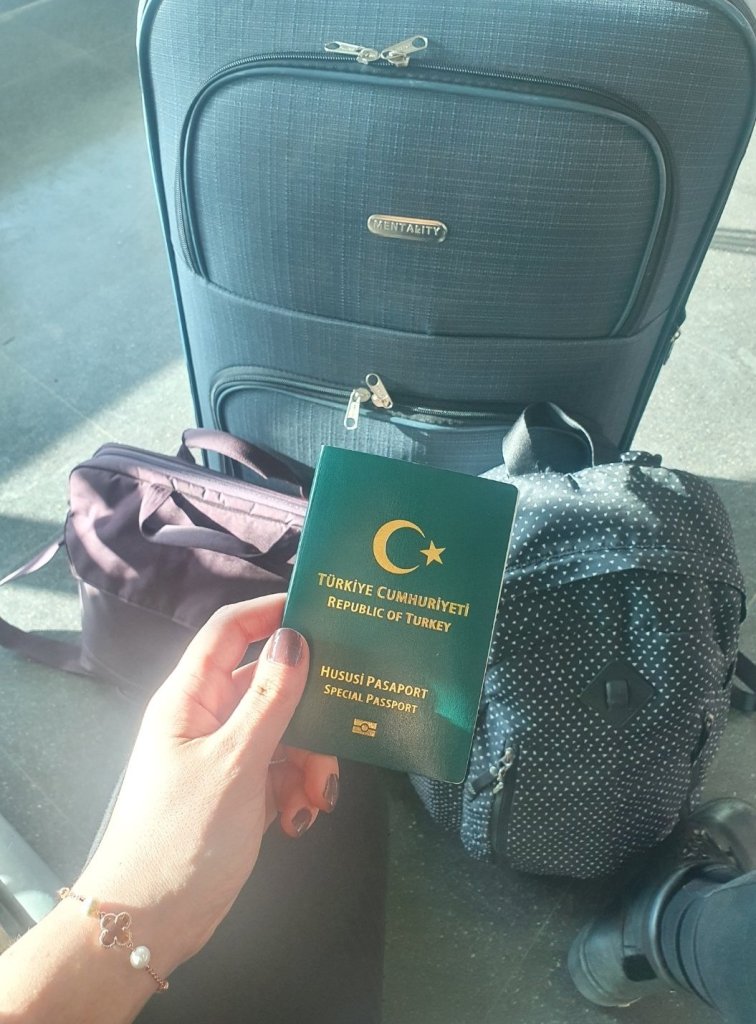
European Solidarity Corps (ESC) under the Erasmus + Programme.
- Which is call as a Mobility ( hareketlilik ).
- The total duration of the mobility max can be 12 months for a participant.
- This was my first Evs project and it gives you so much good things I think everybody in their life at least should try once .
- The flexibility and self management of the volunteering was also good I came home 2 week ago the way it should be and that was okay.
- What I know and what I can learn from this internship developing as much as I can personally and professionally.

- Erasmus + stages ;
- Stage 1 Youth exchange
- Stage 1A Vocational Education and Training
- Stage 2 Training Course
- Stage 3 Volunteering
- Stage 4 Internship / Traineeship
- Stage 4A Adult Mobility of Staff
- Stage 5 Strategic Partnership & Capacity Building
- Stage 6 Structure Dialogue
- The Erasmus + Programme is structured in three key actions
- Key action 1 is the learning mobility opportunities for individuals both young people and youth workers
- Key action 2 focuses on strategic partnerships aiming at innovation and quality and strengthening cooperation among different sectors and actors ( public , private , non governmental and others) in the field of youth work.
- Key action 3 offers opportunities for young people to influence policy making and reforms by entering into dialogue with policy makers.
Main Responsibilities of Coordinating and sending organization
- Assists the volunteer with international travel arrangements and provide travel tickets
- Gives all necessary information about the Erasmus + Programme and the Esc.
- Provide the info Kit to the volunteer and give all clarification asked by the volunteer
- Supports the volunteer to get a visa if needed
- Makes the pre departure training
- Helps the volunteer to arrange the European Health Insurance Card before the project starts.
- Keeps the contact with the volunteer during the project at least once a month.
Responsibilities of The Receiving organization
- Provides decent and safe working conditions to the volunteer.
- Foresees crisis prevention and crisis management mechanisms.
- Provides emergency support.
- Offers to the volunteer the opportunity to carry out well defined set tasks , allowing some of volunteer ideas, creativity and experience to be integrated.
- Provides suitable food to the volunteer.
- Provides linguistic support and training.
Responsibilities of Volunteer
- Involved in the planning, implementation and evaluation of the Esc activities.
- Commits him or herself to contribute his or her time , energy and motivation to the best of his/her knowledge to the aims and objectives of the project activities.
- Is responsible for the delivering of the “on line Eu survey” not later than 1 month after the project’s end, but ideally at the end of the ESC service.
- Agrees to deliver to the involved organization: photos, images, videos or other materials of the work done during the Esc project.
- Create media or social network for Receiving organisations social account.
- To fulfill the Evaluation sheet every week and give it to the mentor in the end of each week.
- Is responsible to make a monthly report about the Esc project, with detail info about the tasks in the project , about the tasks in the project about the integration in local community , together with photos.
- Has to keep all boarding cards, and travel documents and give to coordinating organisation for final report.
- Is responsible to prepare his/her part of the mid term and final reports and to give them to the Coordinating Organisation.
- Agrees to fulfill projected Esc rules and responsibilities and in case of failure of the project because of volunteer’s mistake , which is not accepted by National Agency, any financial feedback from National Agency will be reimbursed from the volunteer.
- Will participate in training courses, projects activities, camps, debates, cultural events and civic education.
- Will have an active role in the receiving Organisation. They will be prepared to develop socio/cultural and sport activities together with the Youth Workers and will elaborate his own projects and activities.
- Develop a blog or some articles for our newsletters and website where they can express their experience and share with other youth and public in general.
- Every project has its own number.
- Our project number : Developing Solidarity Value Through Volunteerism
- National agency : Turkish National Agency
Working hours, days off and holidays
- Volunteers will collaborate 35 hours per week during 5 days a week. (30 hours of Esc activities per week and the remaining 5 hours can be used in trainings and evaluation)
- Volunteer have 2 free days each week.
- You have 2 days of holidays per month for the duration of the project. I also use this days.
Accommodation
- The volunteer which mean us lived in a share flat with another volunteers. They provide us clean bedsheets and blankets. We were 5 turkish people and in my room I was with Selcen and we had our own bathroom and balcony.
- Volunteers should bought to tickets. After volunteer give all documents, coordinator organization will pay all amount.
- Visa payments will be done by volunteer, after volunteer give all documents coordinator organization will pay to volunteer.
- Pocket money : 120 eur / month ( 4 eur/ day)
- Food money 88 euro / month
- The first week of every month gonna give you money by coordinator organization.
- First sending organization sends “Volunteering agreement European Solidarity Corps” to the volunteer.
- There are three type of organization; Coordinating and sending organization , receiving (host) organization .
Cigna

On Arrival Training
- On arrival training is the most important part in the beginning of any mobility, as it prepares the participant with all the necessary information , updates and mindset for everything they will face during it.
- We were focusing some management skills which I liked most ; self management, storytelling for impact, finding your purpose, time management, public speaking and culture shock.
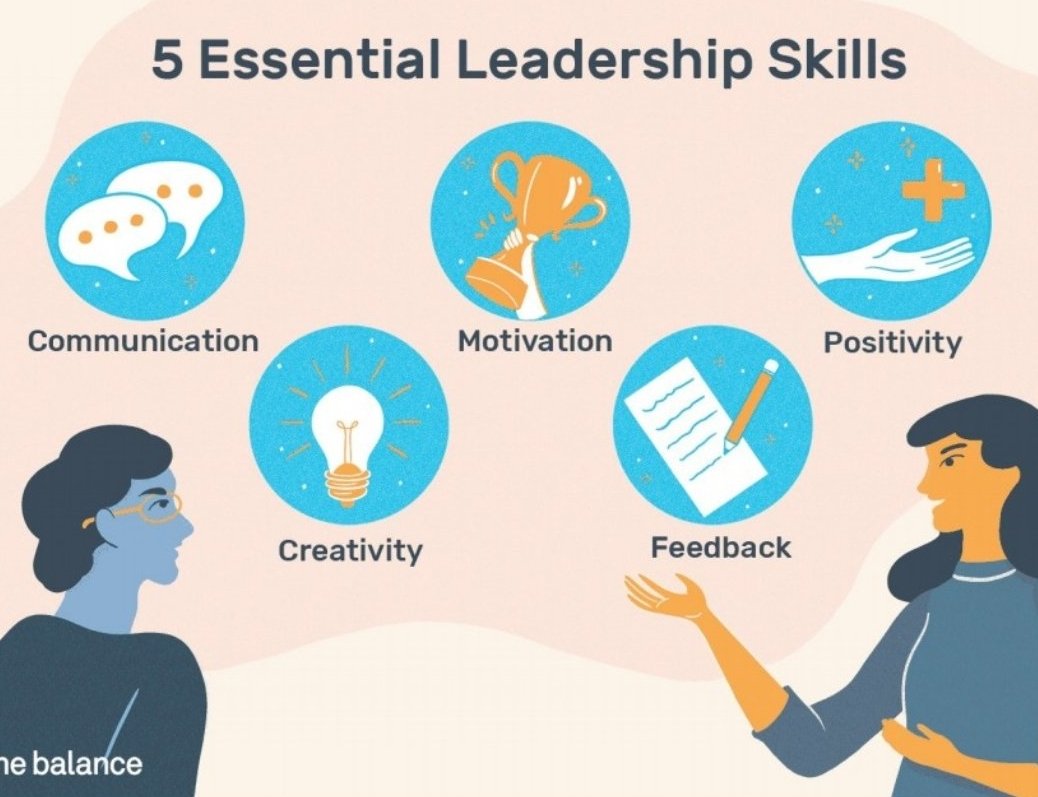
- Soft skills ; time management, team work, flexibility, leadership, positive thinking, being creative, assertive behaviour
Culture Shock
- That will be the first topic because as you know this is arrival training.
- When I first went to Poland I feel culture shock very high level but at this time we were 5 turkish people and Sofia is closer than Erzurum to Bursa and I had knew some knowledge about Bulgarian traditions.
- You can come across Culture Shock when you appeared in a new cultural environment for example: moved from your native country to a foreign country for study or work , or returned home after staying abroad for a long time . I’m writing this blog in first day after Bulgaria and I did not get use to my home and that makes you feel weird in some point.
- When you moved from countryside to a city or the opposite; started a new job; had to adjust to a new social role ; experienced any other kind of transition from a familiar cultural environment to an unfamiliar one.
- W curve model which you feel this when you come back home you are livin second culture shock , you are starting to miss Bulgaria . Right now I’m living W curve culture shock even I knewed I’m gonna live this already. When I was in Sofia I was thinking I am gonna miss this place so much .
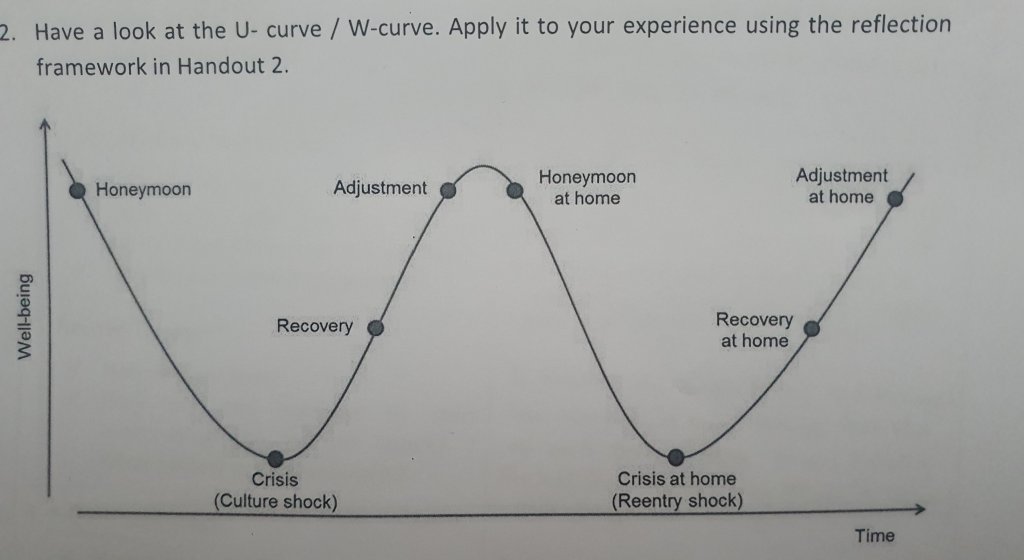
- W culture shock cause greater distress than culture shock experienced in the new culture. The reasons for that include: admiring certain aspects of the new culture absent in the home culture, not admitting the difficulty of readjusting to the home culture, the need to search for identity, the home culture values, beliefs, ways of thinking and living , with which a person was familiar , may have changed or person may have changed.
- Reflection framework ( if we look more closely to our culture shock)
- Situation ( what is your case of cultural transition? Where did you move or what changed ? )
- 1-Honeymoon Stage
- 2-Crisis ( Culture Shock – The Slump) Stage (What difficulties did you face?)
- 3-Recovery Stage ( How did you manage to start overcoming the culture shock? What helped you overcome it ? )
- 4- Adjustment ( Adaptation) stage : (How long did it take you ?)
- Summary : What did u learn from your experience of adjusting to the new cultural environment? ( Broaden my horizon, improved my soft skills )
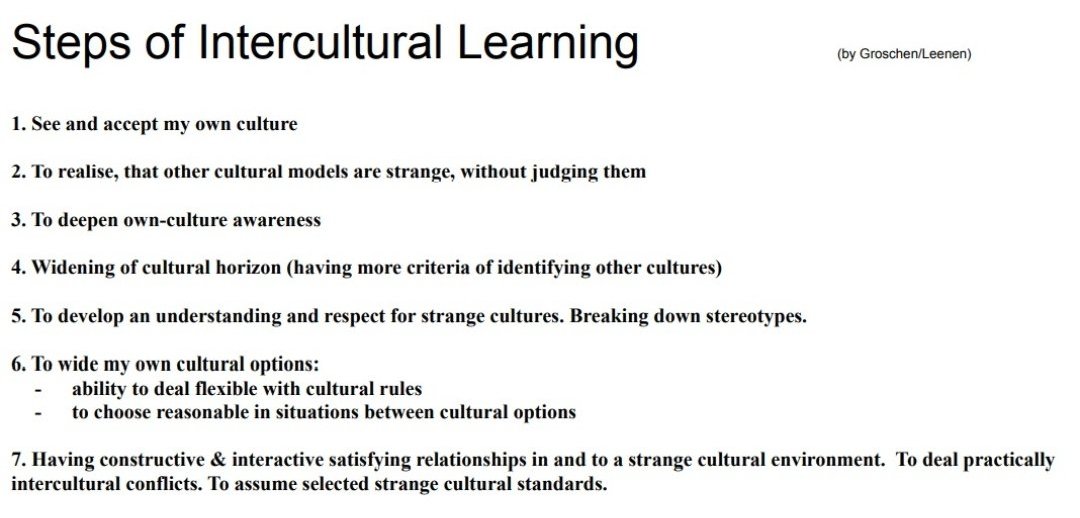
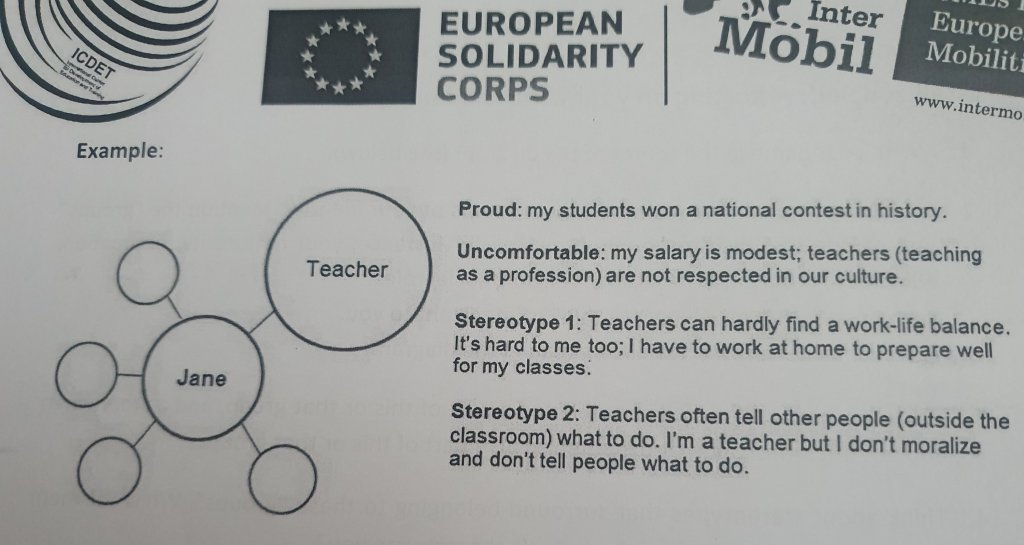
- We were working and communicating with international people so STEREOTYPING was one of the most important subjects for us cause stereotyping people can make hard to communicate with people .
- Stereotyping means you are generalizing something about one certain thing.
- Stereotyping most of the time similar to clishes and consists lots of prejudices. Like Bulgarian people are gypsies.
- Stereotypes can be defined as simplified thoughts and mental generalizations of some group of people when we assume that all individuals in that group have same characteristics.
- Stereotypes can be both positive or negative.
- Prejudice = stereotypes +emotions.
- Stereotypes and prejudges are part of socialization and they are made in very early periods in our lives by the influence of family, friends, media etc. We often adopt them on unconscious level and they often act unconsciously , which make them difficult to change.
The biggest or most prevailing stereotypes in European countries
- Austria
- They all like to drink beer
- Wear funny green hats
- Enjoy yodeling
- Belgium
- People are natural born beer connoisseurs
- They love filling their faces with fries and chocolate
- They re funny breed who take life at a relaxed pace but they can not seem to agree on speaking just one language
- Bulgarian
- Bulgarian men are all macho tough guys ( hahahah)
- All the politicians there are corrupt
- You won’t go far before meeting a gypsy
- Croatia
- The land of beautiful women
- It’s a land of coffeeshops and heavy smokers
- Everyone is supersititious and they are generally a friendly bunch
- Just don’t go getting into arguments about those bad times in the 90s.
- Cyprus
- The sun bleached nation where everyone is a devout Christian
- These tanned skinned islanders live a life of leisure even if they are not rich
- Their doors are always open to the traveler who wants to check out the laid back lifestyle
- Czech Republic
- Where the people can seem hostile and rude at first
- Don’t worry they don’t mean it
- The men spend half their life in the pub watching sports and drinking but the women stay home and cook
- It is easy to spot them as they all have a funny sense of what fashion is.
- Denmark
- One of the place in the world where no one is poor
- In fact , all Danes have good jobs and never worry about being broke
- They re a bit depressed though what with everything being flat and the sky always being Grey.
- For that reason they have a lot of open relationships.
- Some of the men still think that they are Vikings, so they join motorcycle gangs and cause trouble
- Estonian
- Not many people know much about them as they get few visitors
- All the women are tall and attractive
- And the men are quite macho but maybe it’s over now they are saying all Estonians computer genuines.
- We can throw in a few hackers too.
- Finland
- People don’t exactly live the Vida loca.
- It is a functional place and everything is clean but still many people choose to live in the forest in wooden huts where they brew vodka over a log fire.
- Finnish people don’t talk to strangers but they go naked to the sauna with them.
- Here folks enjoy their isolation so don’t be surprised if no one speaks to you. Just do what they do , keep your hand down and enjoy the saunas that are everywhere.
- France
- France is easy because it’s one of the most stereotyped places on the world
- They drink a lot of wine
- They love their food
- Hate the English
- They are a haughty bunch , critical of many things and are not afraid to tell you.
- They seem to have a penchant for the stranger things in life and that’s why they have a history of making very messed up movies or writing books that most of the world think should be banned.
- The French don’t care they re proud of being the world’s avant garde.
- Germany
- Those Germans are just good at everything
- They are never ever late and even take great pains in organizing just a breakfast
- They are all born with an acumen for engineering, but unfortunately that is not helped with their ability to cook cuisine that is not bland. All they seem to eat is sausage and potato and sauerkraut… washed down with beer of course.
- Greece
- Where the folks live a much more laid back life style
- They are all hairy for some reason including the women.
- Nothing is more important than family and you will find the Greeks spending hours around the family table involved in gossiping about someone else’s family.
- Ireland
- Everyone in this alcohol soaked nation likes nothing more than to sing and be merry.
- Don’t make them angry though as the men and women are natural born boxers.
- Soft spoken poets living in Ireland.
- Sigmund Freud said Irish are the only people who are impervious to psychoanalysis.
- Italians
- They just talk and shout and argue with anyone and everyone.
- These people passionate about everything especially food.
- There are yet to grasp political correctness when it comes to sexual relations and for them a bit of wolf whistling is fair game.
- You can say people really enjoy food , football and fashion.
- Luxemburg
- It is so small that it is almost hidden.
- Everyone here has money, and most people work in the Civil service , the steel industry or are farmers.
- They don’t get out much of the country so it’s unlikely you will ever meet one of these mysterious people.
- Imagine a bit of German and French mix, and you re close.
- The Netherlands
- The country of progressive clog wearers who speak perfect English but with a very funny accent.
- These tall blue eyed people like nothing more than to ride around on a bicycle stoned out of their minds.
- If they are not doing that they are tending to their windmill or tulip garden.
- Poland
- The land of the rude people who will not spare your feelings by speaking nice to you about your weight.
- They have taken some grief from Germany and Russia in the past and this has made some of them a little bitter and aggressive.
- Half of the country moved to the UK but now they all went back home to greener pastures.
- Portugal
- People are much more relaxed, relaxed to the point of laziness.
- All the men are handsome and have bronze skin while the women like to cook while listening to Fado music.
- They take life easy for the most part, because they know it will be over soon enough.
- Stop confusing them with the Spanish.
- Kinda like the Indians they have a thing for mustaches.
- Romania
- Poverty is everywhere and small grizzly children live in the sewers.
- They are very religious and some of them believe in witches.
- A past time there is for gypsies to put spells on people.
- Spanish
- They live the joie de vivre even if it means sitting about all day drinking Sangria and watching soccer on TV.
- They don’t care they live in a warm country full of beauty with beaches too.
- They stay up late, flirt all the time, sometimes torture bulls and enjoy the Eurovision song contest.
- Swedish
- These blond haired blue eyed tall people live in the snow .
- They are open minded but suffer from sadness.
- They live in the dark much of the time so it is pretty easy to understand.
- They don’t worry about money or finding good work and they tell jokes about the Norwegians.
- They like pastry, coffee and some weird meats.
- They also keep a very clean house and country .
- UK
- A country stacked with pie eating poor people fighting over soccer and politics.
- They overlords have funny , posh accents and still think they are living in the middle ages.
- The working people like the pub a safe place to hide from the perpetual rain and cold.
- They have white skin that burns easily , drinks a lot of tea and everyone watches hours of telly daily which is full of programs showing them nice sunny places they could visit if they had any money.
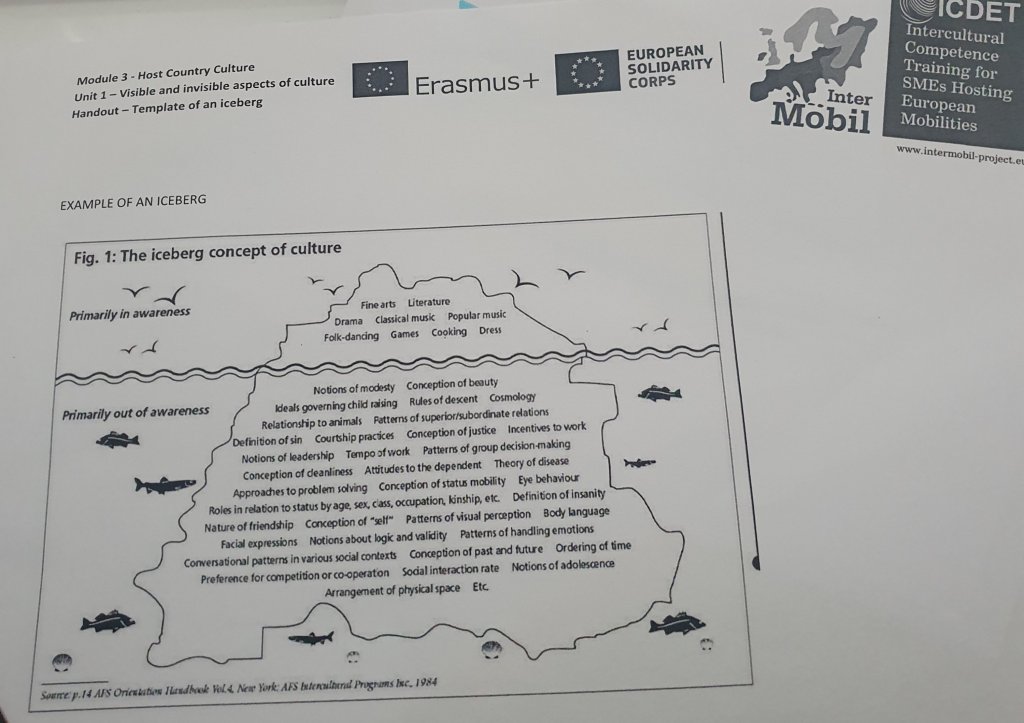

- One of the most well known models of culture is the iceberg. It is main focus is on the elements that make up culture, and on the fact, that some of these elements are very visible, whereas others hard to discover.
- Like an iceberg, the majority of culture lies beneath the surface.
- In culture there are some visible parts: architecture, art, cooking, music, language, just to name a few. But the powerful foundations of culture are more difficult to spot : the history of the group of people that hold the culture, their norms, values, basic assumptions about space, nature, time, etc.
- The iceberg model implies that the visible parts of culture are just expressions of its invisible parts. It also points out, how difficult it is at times to understand people with different cultural backgrounds because we may spot the visible parts of their “iceberg”, but we cannot immediately see what are the foundations that these parts rest upon.
Self Management
- Self Management is the process of taking care of your personal and emotional health. This includes self reflection, personal renewal time (this is time you use to do things you enjoy) . Like yoga, stretching, take a walk, run or bide bike, participate in an organized sport , join a dance or martial arts class.
- Examples of self management : personal hygiene (how you look and feel can affect your mood ) , diet and exercise (what you eat and how often you move can affect your mood ).
- Stress management, exercise, deep breath or take a break can be a way to manage your stress.
- Self reflection , taking some time to reflect on yourself and your recent recent decisions can be important to self management.
- Taking time on reflect on who you are and what you stand for is important in self management. Reflection on yourself can help you understand what you need to function in life.
Time management
- Working on time management skills now can make organizing these future commitments far easier.
- Time management is the “analysis of how daily hours are spent.”
- In our Evs project time management was a huge deal for Icdet. We were planning our weekdays beginning of the week and share with the group.
- Time management tools ; keeping a calendar, creating a to do list, setting reminders in your phone or on your home computer.
- Procrastination ( delaying) is the worst thing in time management.
- Procrastination is the habit of waiting to do a task until the last minute.
Cycle of time management
- Plan
- Do
- Check
- Act
Check ” The philosophy of time management ” in TedxConcordia by Brad Aeon
Multitasking
- It’s the ability to do multiple things at the same time .
- Doing your homework and listening to a new song by your favorite artist.
Finding your purpose
- 1-What do I love to do ?
- 2-What problem needs to be solved ?
- 3-What are your talents?
- Time to combine them.
- For example : writing + bullying + creating little plays = writing and directing plays that kids could perform in schools with an antibullying message.
- Baking with my mom + climate change + instagram = creating instagram stories to sell baked goods to raise money for climate change organizations.
Storytelling For Impact
- Storytelling subject was kinda hard for me .
Public Speaking

- When I talked some community I was always so excited and speaking very fast.
- It’s important to do
- 1- Audience analysis ( demographics like age, race, ethnicity, martial statues, income and psychographics like religion, political party affiliation, hobbies)
- 2-Selecting your main points
- 3-Researching your topic / main points
- 4-Outlining (Anahat) You can start with the Body of your speech instead of your introduction or conclusion.
- 5- Rehearsal ( Prova) , do not read from your notes word for word, speak loudly, smile, keep your eyes on the audience.
- The order of events : your opening line and preview statement, your first /second/ third main point, your memorable closing statement.
- And do not memorize your speech word by word if you forget one line, it is easy for your mind to get derailed and forget the rest of your speech.
- Positive thinking goes a long way, make sure your self talk is positive.

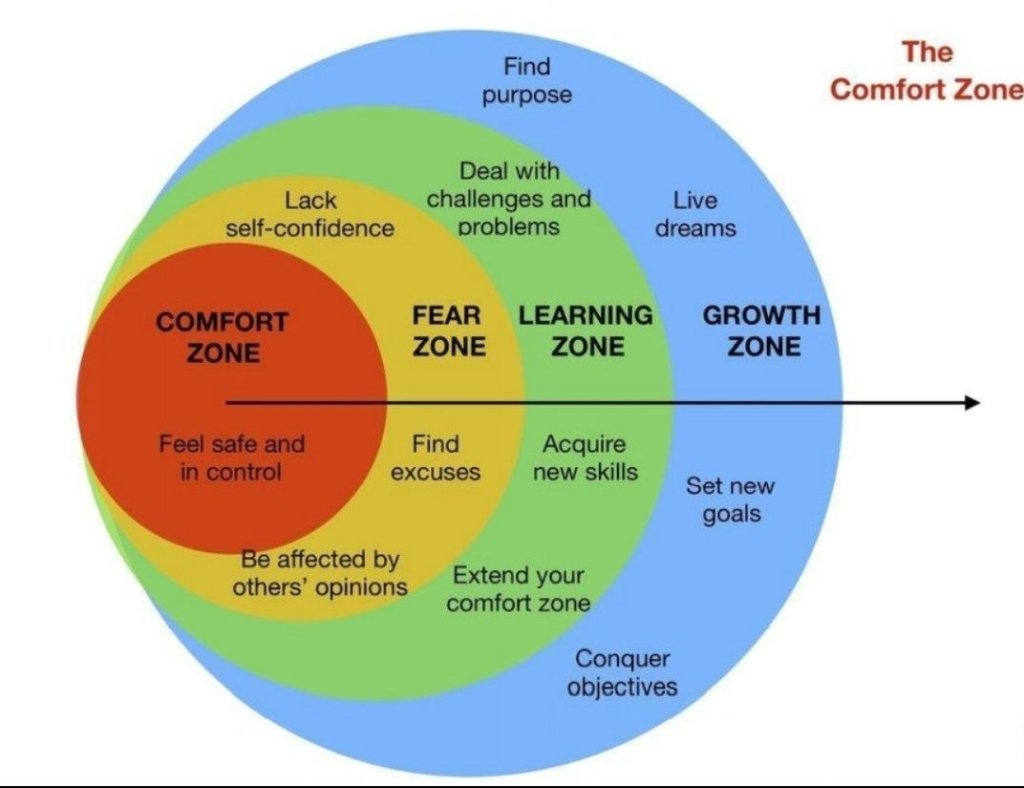
- Three zone ;
- comfort zone that is home,
- fear zone that means lack of confidence and
- learning zone which you can improve.
- ICL = inter culture learning , actually in my Evs that was the top thing which I did in whole 2 months.
- Push factors > Pull factor
- If we give an example for a push factors ; I didn’t want to stay in Bursa, that is why I m coming Sofia, I want to broaden my horizon, to meet with different people ( that is why I came this Evs ).
- Example for a pull factors; participate erasmus+ project ( you were wondering about )
- Language Barriers are created by circumstances and people so always adapt to all conditions . Be ready to make mistakes and hear mistakes but remember that they are the outcome of the process of thinking.
- Diversity, is having different cultures respect each other’s differences. Racism, gender discrimination, young equality and human right champions, equity and equality.
- erasmusintern.org
- Salto-youthplatform
- European youth portal
- Eurodesk
- Eures (for looking a job in europe)
- Equality means give same thing like same number or proportion.
- Equity means for the same condition give people what they need.
- Canvas project model , it is business improvement model .
- You can feel Impact when this visibility stuff touch you.
- The manager in the Icdet Ivan told me initiation is kinda your soft skill, and ‘are you manager or engineer, you know everything about management.’
- Gap year it can be between high-school and university or university between work life.
- With gap year you can develop your knowledge and really need to know what you wanna to do in work life.
- SPASS ( specific- productive – attractive directed- self- social) in German methodology mean fun.
- MOOC ( Basic Educational Video)
- Kahoot! is a game-based learning platform, used as educational technology in schools and other educational institutions
- Headless chicken syndrome :
- So your business is up and running, orders are coming in, customers are keen to do business with you, and you find you have a demand for your product or service.
- What a great place to be.
- But, what if you find you can’t keep up – you’re running around like the proverbial headless chicken trying to keep everyone happy.
- You’re bound to trip up, disappoint customers, lose control of your expenditure, and may even end up ill as a result of all the stress.
- If this sounds familiar, you’re not alone, plenty more business owners struggle on through the tough growth stage of a business thinking they need to do everything to stay in control.
- Goals should be purposeful and strive to a positive outcome.
- Goals can be short /mid/long term
- One way to set a goal is by using the Smart goal tactic.
- Specific, measurable, achievable , relevant, time based
- Specific -> what will this goal accomplish? Define your goal.
- Measurable -> how will you determine whether or not the goal has been reached?
- Achievable -> is this goal possible ?
- Relevant -> how is this particular goal related to you currently or in the future ?
- Time based -> when will you complete the goal ?
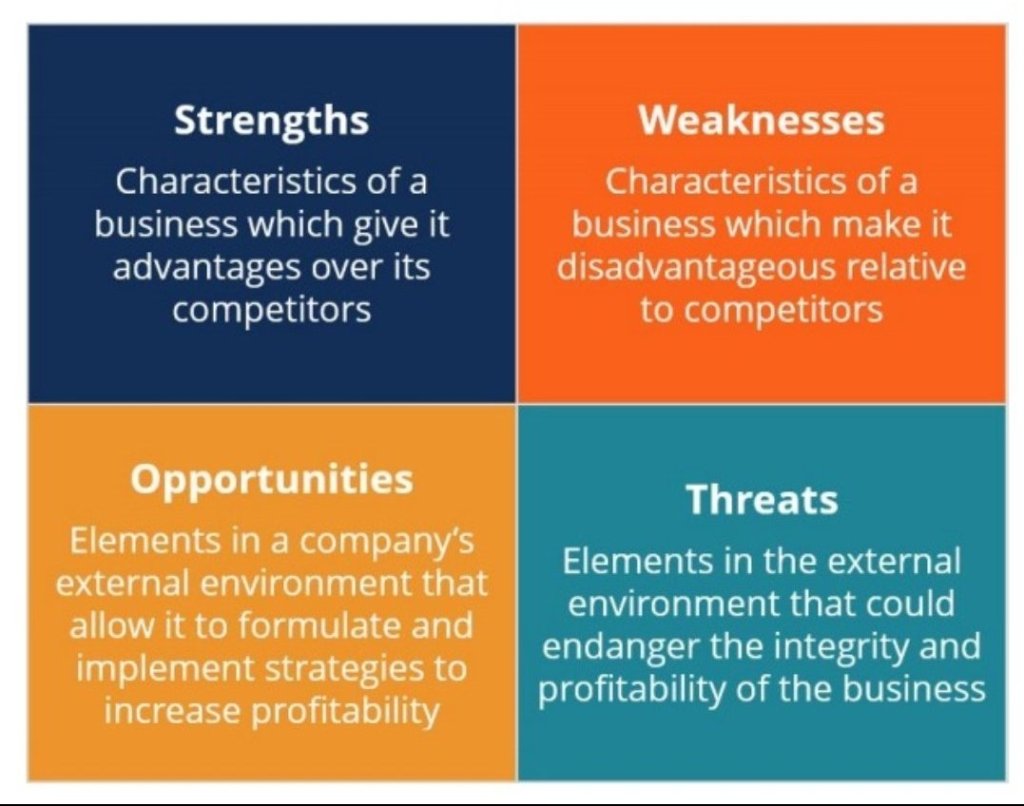
Hard skills, specific to your job and are required for you to actually do your work example if you re a chef cooking would be a hard skill. Generally learned through school training or previous work experience. Hard skills are easy to measure employers can get a good idea of your hard skills by looking at your education previous experience and certifications.
Soft skills are interpersonal and that can be used in every job these include communication teamwork and adaptability. Soft skills are more difficult to develop and harder to evaluate . Usually employers usually have to wait until and interview or your first few weeks on the job to het a good idea of your soft skills.
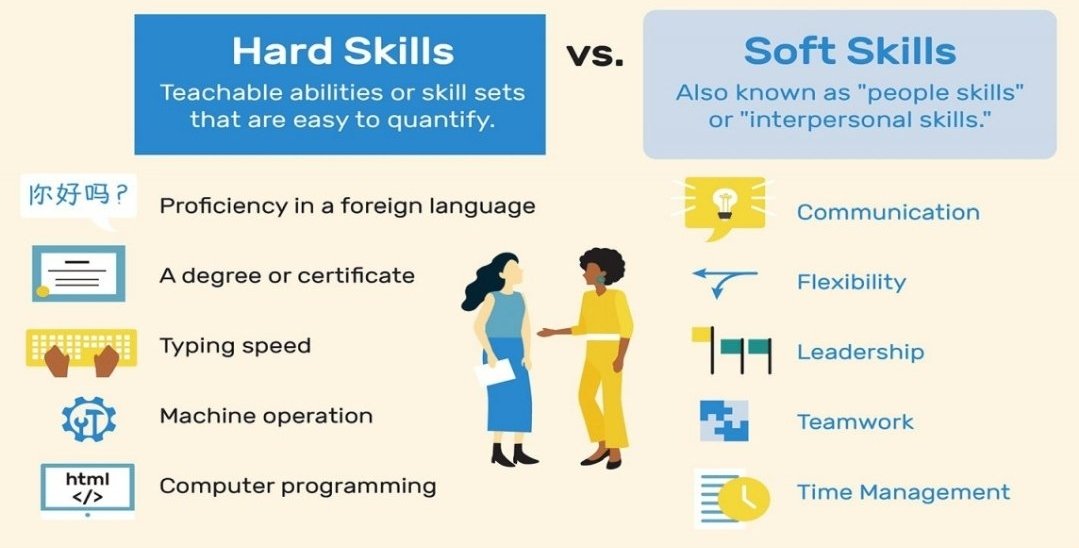
- 15% of success is determined by Hard skills
- 85% of success is determined by Soft skills.
People can get promotions or get fired depending on how well they work in teams, communicate and organize. It is called being an Involver.
Being able to accept changes without complaint will show your flexibility.
A.S.K MODEL OF COMPETENCE
There are three things in life that makes person successful; one is the knowledge the person has, the skills he is develops and the attitude he has. Your knowledge and skills are important what is most important is the attitude which connects you to society . In your life your attitude is more tested than your knowledge and skills. Therefore the most important aspect in life for success is not the knowledge not just the skills it is the attitude a person carries ultimately that holds him in difficult times and make him successful in more tasks.
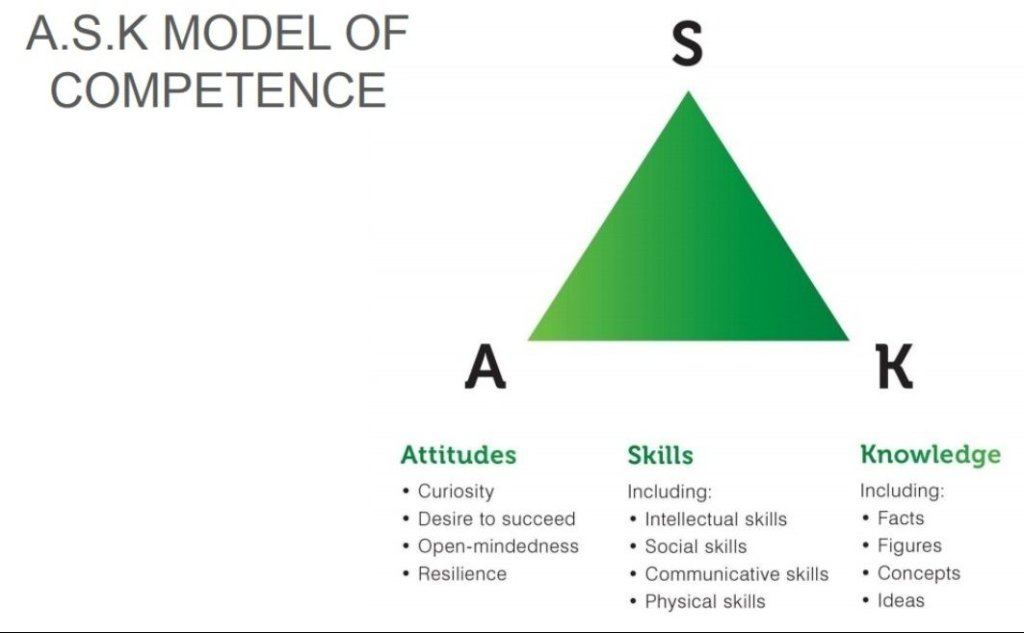
Three whales of learning
- Non formal learning means learning by doing . Like soft skills keep going lifelong and it makes it important for us .
- Nonformal and informal knowledge keep going all life through.
- Formal learning means keep going when you study.
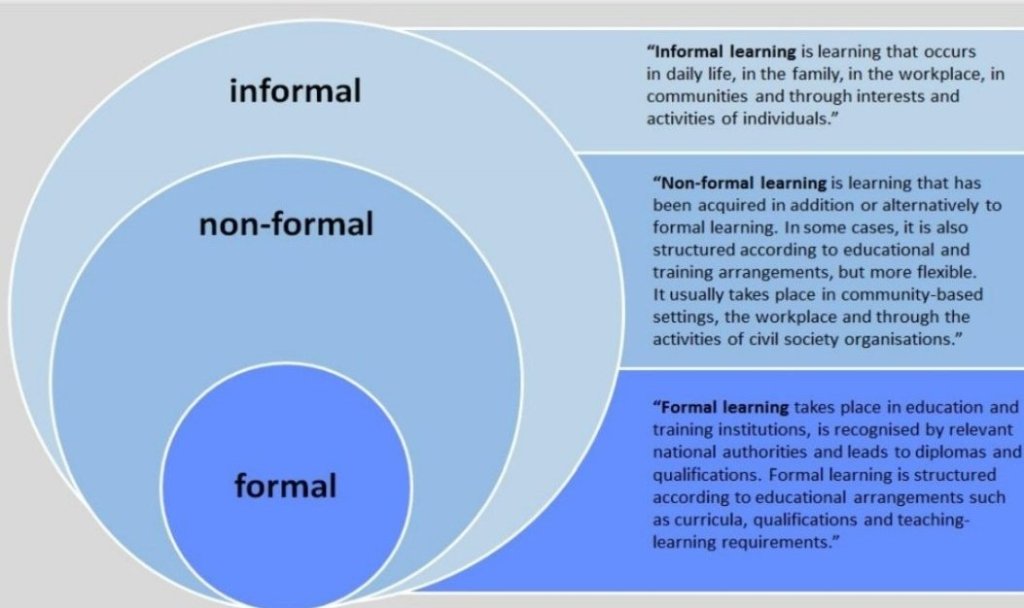
- Formal learning is smt that takes place in schools environment; curriculum and the subject and school syllabus is the teachers work plan .
- Informal learning is the opposite. It’s something that happens in everyday situations. It’s something that is educational and might change your values but the results are viewable much much later.
- Somewhere between these two is non formal learning. It is purposed and might be planned like formal education but it is more flexible and available for everyone. And most importantly it should happen voluntarily. Non formal education is social and individual learning. It is smt that you can do extracurricular activities where you use active and interactive study methods. Your own idea and aim to educate yourself . Like learning a new skill, like playing a guitar through YouTube videos.
- Learning it is smt that can influence you, smt that brings out emotions and allow yourself to find answers to certain questions that you are looking for,requirements that you want to fulfill. You need to have belief in yourself and your self esteem that you can manage obtaining that value .

- It is said that in average a person can think about 800 words a minute. But we can only speak about 120 words per minute. Therefore it is evident that there is enough free energy and time for a listener to not only pay attention to what he said but at the same time make connections and think about how to actually implement what he said in the real life.
- And if you teach knowledge someone you can learn 90% of this knowledge.
- Information means you read , knowledge means stays in your mind.
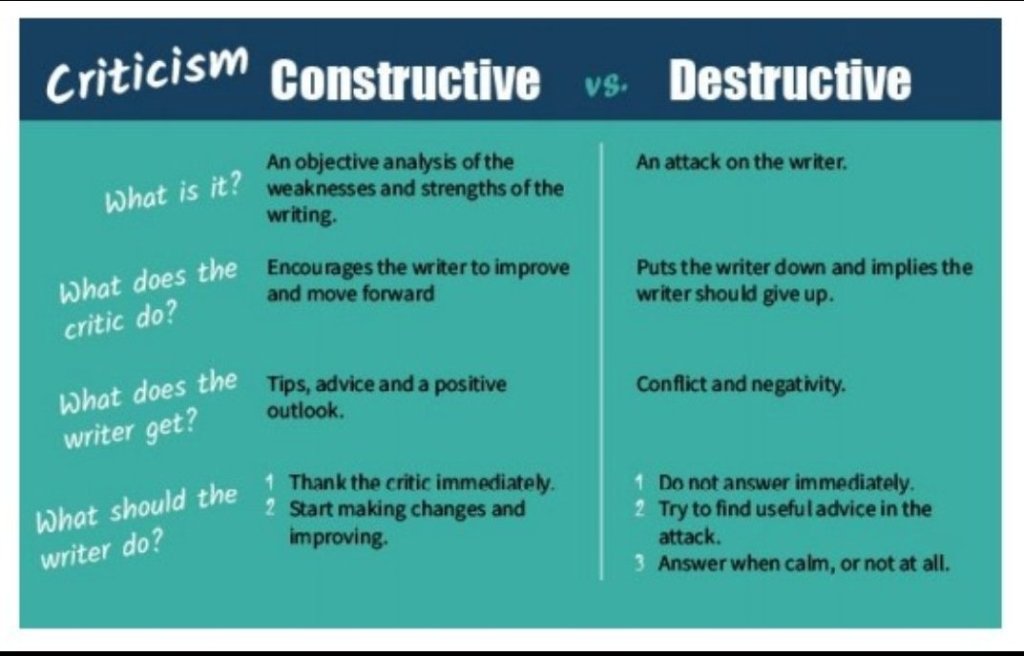
Is this criticism helpful or destructive
- Constructive criticism is a technique a criticism uses to encourage a person to improve and move forward.
- It is an objective analysis of the weaknesses and strengths of one’s work , and ends with tips and advice.
- As a result, the writer may be more confident, more inclined to try again, and strive to never give up.
- Destructive criticism is an attack on the writer instead of an analysis of the writer’s skill set. It creates conflict, transfers negative energy, lays blame, and puts the writer down.
The rules
- Be on time
- Plan your week
- Plan your day
- Respect others
- Microphone rule
- Give to take
Monitoring plan
- In Mondays action plan creation
- Friday meetings
- Weekly reports
Evaluation
- Weekly
- Midterm
- Final
The things we did in project
- Arrival article you gonna write about what is your expectation from Icdet, EVS, volunteering, Bulgaria .
- And we had meeting because of pandemia usually online in Friday between 4-6pm .
- Also volunteers and interns have Education ( you need to find smt which you want to improve youself) and Hack ( Practice- Just do smt) day
- A Hack day is an event to crew teams to gather and collaborate on ideas that can help solve challenges in the organization or related to the wider educational and training development field. It is also a good opportunity to team to experiment with new ideas, try out new tech and maybe get to work with someone they have not worked with before.
- Bulgarian class , this event was not obligatory but if you gonna live in there 2 months at least you should know basics.
- Fridays you need to fulfill Weekly evaluation and final form.
- And you have 2 free days in one month which you don’t have to do anything, just tell your manager.
Activity Classifier
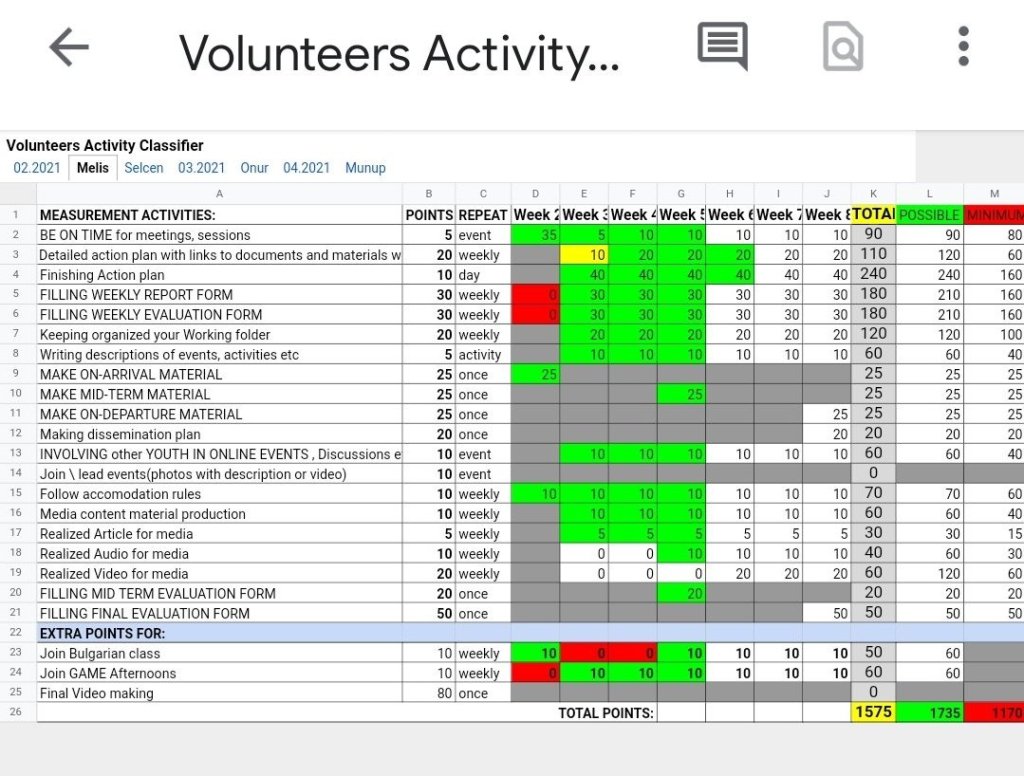

 Melis
Melis 